RezeptrxRezeptrx
FeaturesPricingFree doctor pageBlogAbout
Sign inStart free trial

Product

  • Clinic software by specialty
  • Dental clinic software
  • Compare clinic software
  • Free doctor page

Free tools

  • Medical calculators
  • Medical certificate

Resources

  • Blog
  • NMC & NDC social media guidelines
  • Help center

Company

  • About us
  • Contact us
  • Twitter
  • LinkedIn

Legal

  • Privacy policy
  • Terms of service
  • Cookie policy

© 2026 Rezeptrx. All rights reserved.

Made within India
v1.0.0
  1. Home
  2. /Blog

Telemedicine in India (2025): Practical Guidelines for Clinics

26-Sep-2025 · 7–9 min read

  • telemedicine
  • compliance
  • clinic operations
  • india
  • ndhm

TL;DR — Use telemedicine when it’s safe, informed, and documented. Capture consent, verify identity, write clear e‑prescriptions, and keep structured records. Build a simple, repeatable workflow so your team always knows the next step.

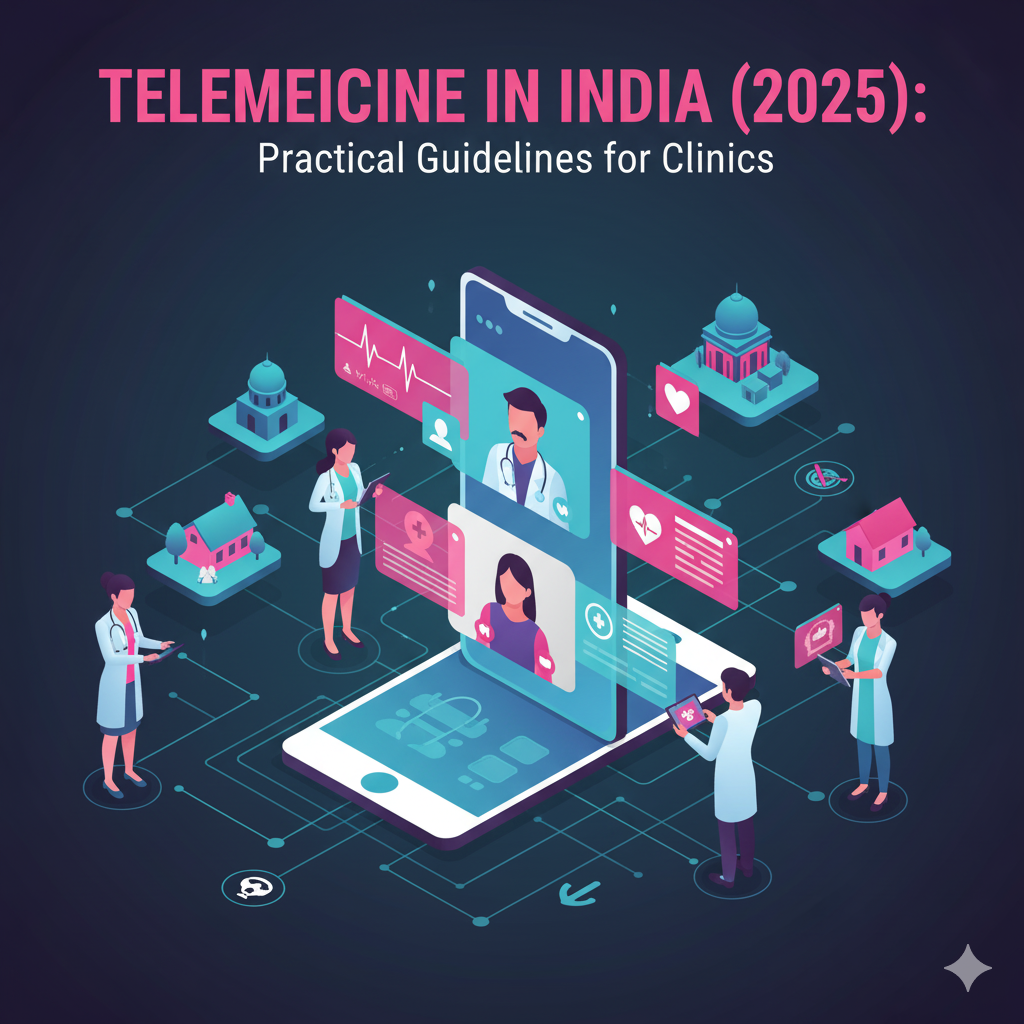
Doctor on a video call reviewing a patient’s record

What Counts as Telemedicine?

Telemedicine is providing clinical care remotely via text, audio, or video. In Indian OPDs, it’s commonly used for quick follow‑ups, medication refills, triage, and counseling.

Typical Modes

  • Text/Chat (asynchronous)
  • Phone (audio, synchronous)
  • Video (synchronous)
  • Store‑and‑forward (images/reports for review)

Practical tip: Use video when you need better context (rash, gait, wound), and switch to in‑person immediately if red flags appear.

Consent and Identity

  • Consent can be implied (patient initiates) or explicit (clinic initiates). Record who initiated, time, and channel.
  • Verify identity briefly (patient name, age, phone, known ID, or previous MRN).
  • Record caregiver details if someone speaks on the patient’s behalf.

Documentation Essentials

At minimum, capture:

  • Date/time and mode (text/audio/video)
  • Who initiated the consult and consent status
  • Chief complaint and brief history
  • Assessment with limitations of remote exam
  • Advice/plan and warning signs for escalation
  • Follow‑up window and preferred channel

Store summaries in your EMR so future providers see the same information.

Prescribing — Keep It Safe

  • Prefer in‑person for new/complex cases and anything requiring a physical exam.
  • For remote follow‑ups, stick to clear, low‑risk medications and refills when clinically appropriate.
  • Include drug name, strength, dose, route, frequency, duration, and instructions in your e‑Rx.
  • Avoid controlled substances and any medicine that you cannot reasonably justify without examination. When in doubt, ask for an in‑person visit.

Disclaimer: Regulations and local council guidance evolve. Use professional judgment and refer to current governing norms. This is educational content, not legal advice.

A Simple Clinic Workflow

  1. Triage request: verify identity, assess suitability for remote consult.
  2. Capture consent (implied vs explicit) and log the mode (text/audio/video).
  3. Conduct consult with structured notes and limitations noted.
  4. Issue an e‑prescription or advice note; share a patient copy (PDF/WhatsApp/SMS link).
  5. Educate on warning signs; schedule follow‑up or in‑person visit.
  6. File documentation in EMR; update active problems and medication list.

Red Flags — Switch to In‑Person

  • Severe pain, breathlessness, altered sensorium
  • Chest pain, stroke symptoms, trauma
  • High‑risk pediatrics or pregnancy concerns that need examination
  • Any situation where visual exam or vitals are critical

Privacy, Security, and NDHM/ABDM

  • Share minimum necessary information; avoid group chats.
  • Use official clinic numbers/devices; avoid personal phones for record continuity.
  • Keep audit logs and backups. Train staff on basic privacy hygiene.
  • Prefer tools that can export structured summaries and interoperable formats.

FAQs

Can I prescribe via text only?

Sometimes for simple, low‑risk follow‑ups with adequate history. If anything is unclear, escalate to video or in‑person.

Do I need a digital signature for e‑Rx?

Clinics typically use a clearly identifiable e‑prescription with doctor’s name, registration, and contact. Follow your council/insurer norms and clinic policy.
How long should I store teleconsultation records?

Follow your clinic’s retention policy and applicable regulations. Many clinics mirror their OPD retention policy for remote consults.


Keep learning:

  • EMR vs EHR: What’s the Difference?
  • What is EMR Software?
  • NDHM/ABDM Compliance Guide
  • Why Clinics Must Go Paperless
Previous post
DPDP Act Compliance for Clinics: A 2025 Checklist
Next post
PCS Codes Demystified: Procedure Coding Playbook for Indian Providers
Contents
  • What Counts as Telemedicine?
  • Typical Modes
  • Consent and Identity
  • Documentation Essentials
  • Prescribing — Keep It Safe
  • A Simple Clinic Workflow
  • Red Flags — Switch to In‑Person
  • Privacy, Security, and NDHM/ABDM
  • FAQs
  • Can I prescribe via text only?
  • Do I need a digital signature for e‑Rx?
  • How long should I store teleconsultation records?